
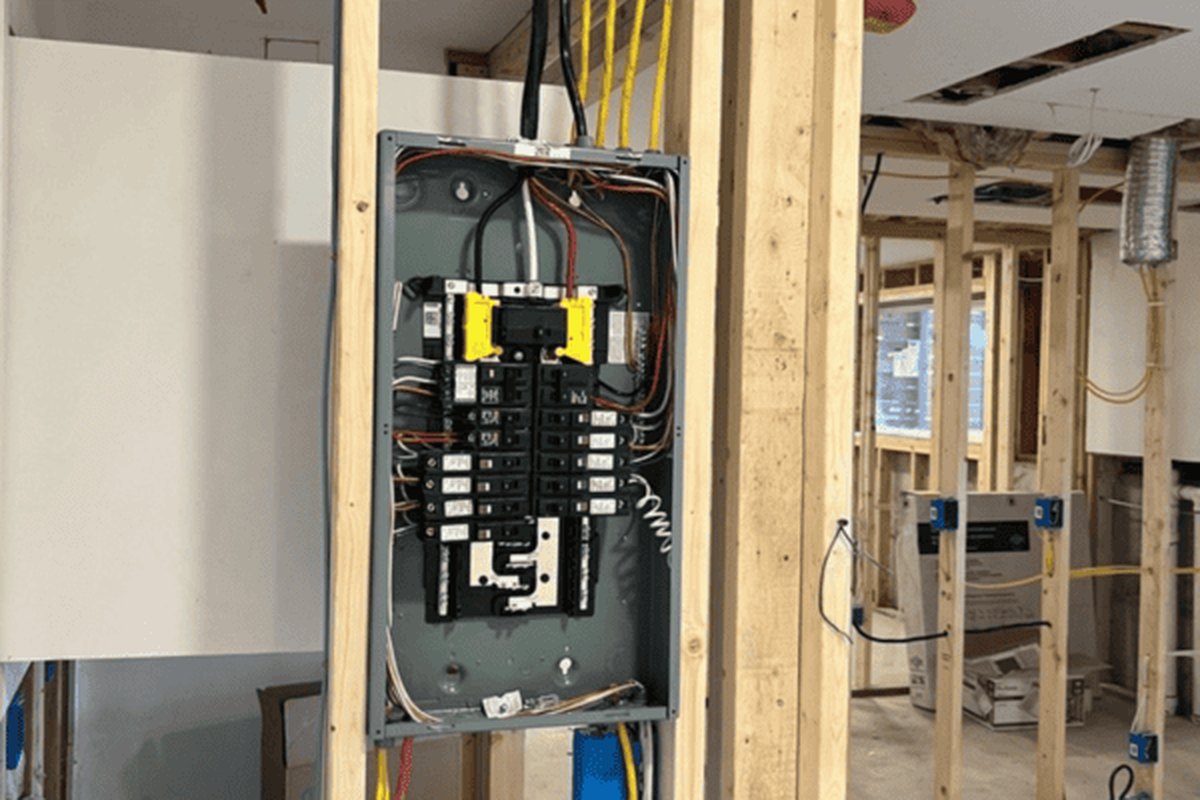
We get the same call every August. It is 88 degrees, somebody finally gave in and bought a portable air conditioner, and now the breaker will not stay on. The person calling is usually a little embarrassed, like they broke something. They did not. The breaker did exactly what it was built to do.
Still, it is worth understanding why it happened, because the fix people reach for first is often the wrong one, and occasionally a dangerous one.
Seattle houses were never built for this
Most of the homes we work in around Ballard, Wallingford, Greenwood and Phinney Ridge went up between 1910 and 1950. Nobody was planning for air conditioning. For most of the last century you did not need it here. You opened a window in July and that was the end of it.
Then summers got hotter, wildfire smoke became a regular August guest, and now half the city is running a portable AC and an air purifier in the same room, on wiring installed when a toaster was a luxury appliance.
So the math stopped working. Here is the actual math.
What your circuit can really handle
A standard 15-amp circuit at 120 volts gives you about 1,800 watts on paper. But for anything running hours at a stretch, and an AC on a hot afternoon absolutely counts, you should only load it to 80 percent. That is roughly 1,440 watts. That is your real ceiling.
Now look at what people plug in:
- Portable air conditioner: 900 to 1,400 watts
- Space heater (same house, different season): 1,500 watts
- Microwave: 1,000 to 1,200 watts
- Hair dryer: 1,500 watts
- Air purifier: 50 to 100 watts
The AC alone can eat your whole circuit. Add anything with a heating element on the same run and you are done. And remember, the outlets in one bedroom are often on the same circuit as the hallway, the next bedroom, and sometimes a bathroom you would never think to check.
That is the whole mystery, most of the time. It is not a fault. It is arithmetic.
The one thing you should never do
Do not put a bigger breaker in.
I want to be blunt about this because we still find it in houses, and whoever did it usually thought they were being clever. A 15-amp breaker is protecting 14-gauge wire, and that wire is rated for 15 amps and no more. Swap in a 20-amp breaker and yes, the tripping stops. But the wire inside your walls is now allowed to carry more current than it was ever designed for. The breaker was the safety device. You just removed it.
Nothing dramatic happens on day one. That is the problem with it. It fails quietly, inside a wall, sometimes years later.
The same goes for daisy-chained extension cords and power strips feeding an AC unit. A portable AC should go straight into a wall outlet, full stop. Those thin orange cords from the garage are not rated for that kind of sustained draw, and they get hot in the middle where you cannot see them.
What to try first, free, takes ten minutes
Before you call anybody, move the load around. Genuinely, this solves it more often than people expect.
- Unplug the AC and plug it into an outlet on a different wall, ideally a different room, then reset the breaker.
- Make sure nothing else heavy is running on that same circuit.
- Watch it for an afternoon.
If it holds, you had an overload and you have just redistributed it. That is a legitimate fix, not a workaround. Plenty of people live happily like that for years.
When it is not just an overload
Some of these calls are different, and these are the ones I would rather you did not sit on:
- The breaker trips instantly, before the AC is even switched on. That is not load. That is a short or a ground fault on the circuit.
- The outlet or its cover plate is warm. Outlets should be room temperature. Always.
- You smell something. Hot plastic, a fishy smell, anything burning. Shut the breaker off and call somebody.
- Discoloration or scorch marks around the slots of an outlet.
- Several different breakers tripping, or the main going. That points at the service, not one circuit.
- A breaker that feels loose or will not reset firmly. Breakers are mechanical parts and they do wear out.
And please do not reset a tripped breaker over and over. Once is fine. If it goes again, stop and find out why. Repeated resetting on a real fault is how a nuisance turns into a fire.
The permanent fixes, in the order we would suggest them
If moving things around is not enough, say the room genuinely needs an AC, an air purifier and a computer running all day, there are three real options, and they are not equally expensive.
A dedicated circuit. We run a new circuit from your panel to that room and the AC gets a line to itself with nothing to fight over. This is the answer for most people and it is the smallest of the three jobs. If you are only trying to solve one hot room, start here. See dedicated circuits.
A subpanel. Worth it when a whole area is starved rather than one room: a finished basement, a converted attic, a garage shop. Subpanel installation puts breaker space where you actually need it.
A service or panel upgrade. The bigger one, and honestly not everybody needs it. But if your panel is full, or you are still on 100 amps and also thinking about an EV charger or a heat pump, it stops being about the air conditioner and starts being about the next ten years. We run a load calculation first, because guessing at this is how people pay for capacity they will never use. More on panel upgrades.
One more thing about older Seattle houses
If your home still has knob-and-tube wiring anywhere, and a surprising number in the older neighborhoods do, usually hiding in a room or two after a partial update, a portable AC on that circuit is a bad idea. There is no ground, the insulation is often brittle by now, and it was never meant to carry a modern continuous load. If you are not sure what you have, an electrical inspection answers it in an afternoon. See also knob-and-tube rewiring.
The short version
A tripping breaker on a hot day is usually your house telling you that circuit is carrying more than it was built for. Move the load, never upsize the breaker, and if anything is warm or smells wrong, stop and get eyes on it.
If you want somebody to look at it, we are at (206) 414-1211 or you can book online. We have been doing this around Seattle for over twenty years, and we will tell you honestly if the answer is moving your AC to a different outlet and spending nothing.