
Every year it goes the same way. The first real windstorm comes through in late October or November, a few hundred thousand people lose power for anywhere between four hours and three days, and for the next two weeks our phone does not stop.
By then everybody wants the same thing at the same time, equipment gets scarce, and permits and utility scheduling take as long as they take. Nobody gets backup power installed during the outage. That is just not how it works.
Which is why I am writing this in August. If you have been thinking about it, this is the window.
First, work out what you actually need to run
This is the step people skip, and skipping it is how they end up spending far more than necessary.
Sit down and write the list of what genuinely has to keep running. Not what would be nice. What has to. For most households it is shorter than expected:
- Refrigerator and freezer
- The furnace or heat pump fan (in a Seattle November this is the one that matters)
- A few lights
- Internet router and phone charging
- Well pump, if you are out past the city water lines
- Any medical equipment, which changes the whole conversation and moves you straight to automatic
That list is your answer. A house that needs those things is a very different job from a house that wants the whole panel live including the hot tub and the electric range.
We do this calculation before quoting anything, because sizing a generator off a wish list instead of a real load is the most common way people overspend on this.
The three real options
Portable generator with a transfer switch or interlock
The affordable path, and for a lot of families it is genuinely the right one. You already own or buy a portable generator, and we install the piece that makes it safe and legal to connect: either a transfer switch or a generator interlock kit at your panel.
The trade-off is that it is manual. When the power goes, somebody has to go outside in the weather, start it, and plug it in. Fine if you are home. Less useful if the outage starts while you are at work and the freezer is full.
Standby generator
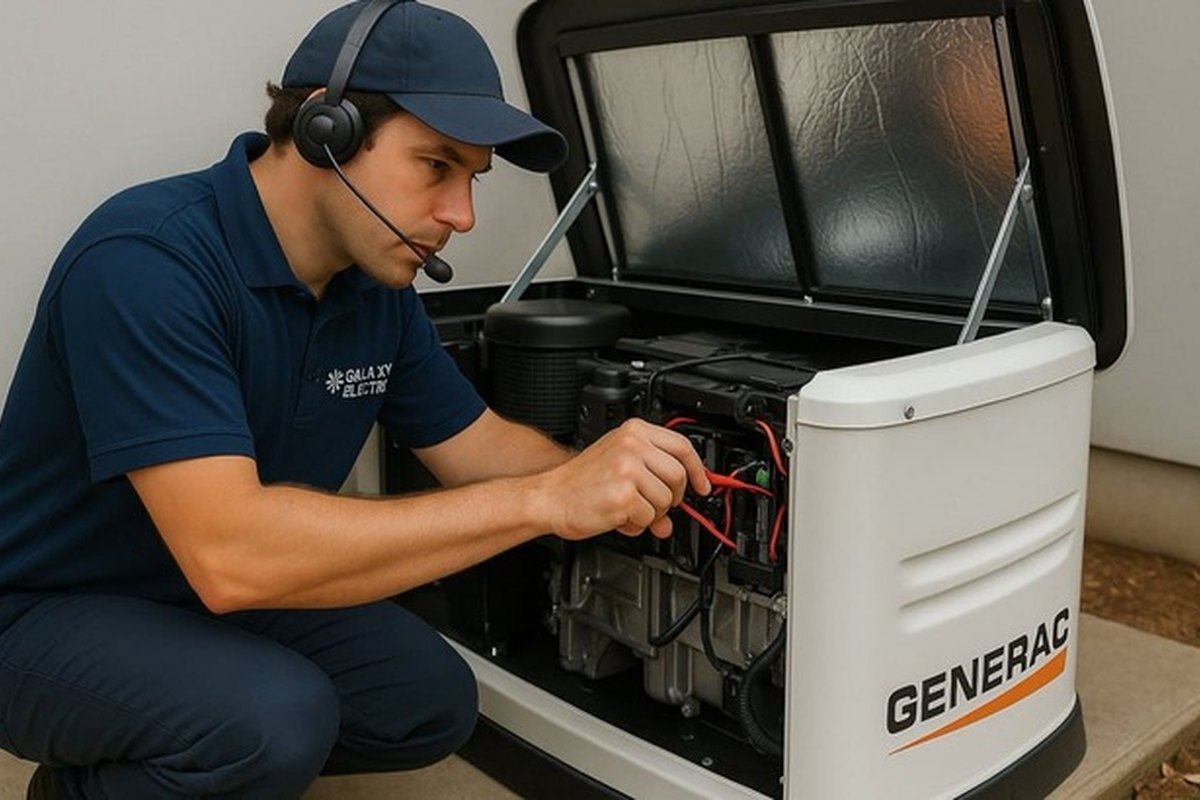
Permanently installed outside, runs off natural gas where the line already exists or propane where it does not, and starts itself. Power drops, it comes on within seconds, you barely notice. It also tests itself weekly, which is the part people forget matters, since a generator that has sat untouched for three years is a generator that will not start when you need it.
This is the option for people who travel, who work away from home, who have medical needs, or who simply do not want the outage to be an event. See generator installation and Generac installs.
Battery backup
Silent, no fuel, nothing to start, no exhaust. Excellent for the four-to-eight-hour outages that make up the large majority of what actually happens around here, and it pairs naturally with solar if you have it or plan to.
The honest limitation is capacity. A battery gets you through an evening comfortably. It will not run an electric furnace and a dryer for two days. If you want that, you are looking at a generator or a much bigger battery bank. See battery installation and backup power solutions.
The thing that actually kills people
I would rather be dramatic here than polite.
Do not run a generator into a wall outlet with a double-male cord. People call it a suicide cord and the name is accurate, but the person most likely to be hurt is not you. Backfeeding sends power out of your house and onto the utility line that a lineman upstream believes is dead. It also has no protection whatsoever on your side.
The transfer switch or interlock exists precisely to make that impossible. It physically prevents your generator and the utility from being connected at the same time. That is not paperwork. That is the entire point of the device.
The other one: never run a generator in a garage, on a covered porch, in a carport, or near an open window. Not even with the door up. Carbon monoxide is what makes the news after storms, every single year, and the victims are usually people who did what seemed reasonable at the time. Twenty feet from the house, exhaust pointed away, outdoors properly.
Why the timing genuinely matters
A backup power install is not a same-day job, and it is not just our schedule involved. Depending on the option and where you are, there can be an electrical permit and inspection, a gas line to run or confirm, a concrete pad to pour and cure, and sometimes utility coordination. Any of those can add weeks.
Inside Seattle city limits, electrical permits go through the City of Seattle. In Bellevue, Kirkland and Everett the city runs its own program. Most other places around here go through Washington State L and I. We handle whichever applies, but none of them move faster because there is a storm coming.
Start in August or September and it is a relaxed project. Start in November and you are in a queue with everybody else.
What we would tell a friend
If your outages are typically a few hours and you are usually home, a portable generator with a proper interlock is plenty. Do not let anybody talk you past that.
If you work away from home, travel, run a home business, or anybody in the house depends on powered equipment, go automatic. The premium buys you not having to be there.
If you have solar, or you hate noise, or your outages are short, look hard at a battery before assuming you need a generator.
And if you are not sure, that is a perfectly good reason to have somebody walk the house with you. We do that for free, and we would rather size it right than sell you something oversized that you resent every time you look at it.
Call (206) 414-1211 or book a visit. We are a licensed, family-run shop, WA Lic. #GALAXES901JZ, serving Seattle and the Greater Seattle area, and every job we do carries a two-year workmanship warranty.